NHI137Neural Harmonic Instrument
Designed, not cloned.
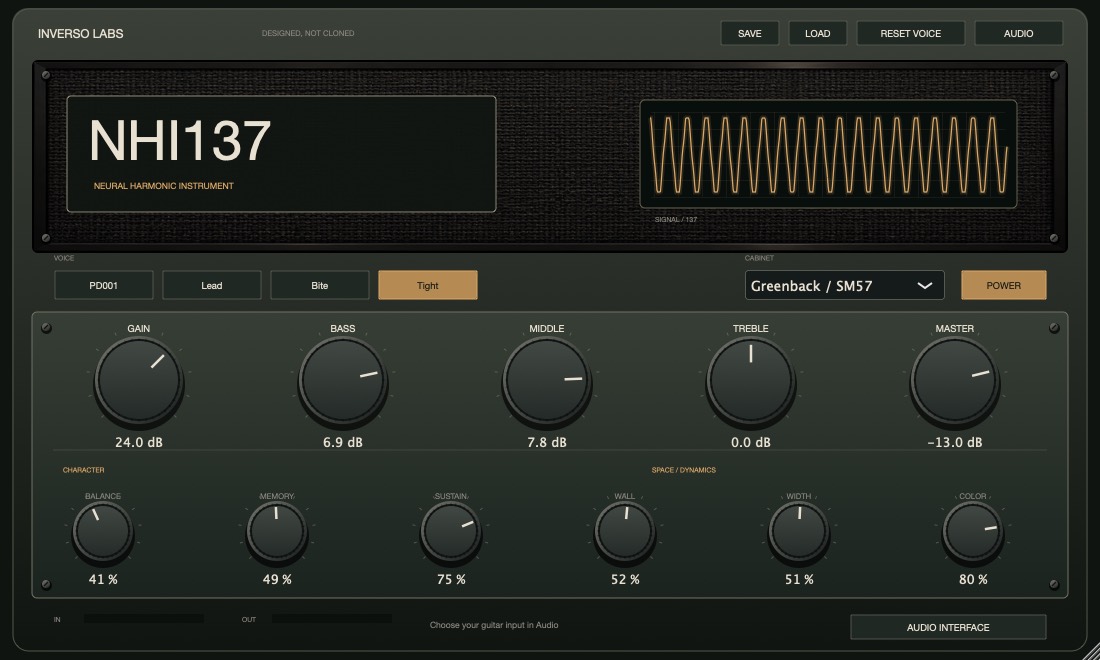
An original DSP amplifier with neural-controlled distortion. Four voices. An evolving harmonic layer. A different kind of energy between the notes.
v0.1.2 · Apple silicon + Intel · macOS 12+ · 44 MB
Standalone app, Audio Unit and VST3. Locally signed; not notarized.
Apple silicon hardware/DAW testing is pending. Installation instructions included.
Windows coming soon.
Beyond the
incoming signal.
The network sets the behavior. DSP makes the sound.
NHI137 reads the energy across three overlapping frequency bands, along with level, attack and your controls. A small trained network updates roughly 6,000 times a second, continuously shaping even- and odd-order distortion in each band.
DSP generates that additional sound and adds it to the selected amplifier voice. The combination is fixed; the neural contribution moves with your playing.
New frequencies.
A distinct character.
Nonlinear curves generate frequencies that were not present at the input. A single tone develops harmonics; multiple tones also produce sum-and-difference components called intermodulation products. Their balance changes the texture, density and edge of the sound.
NHI137 controls squared and cubed signal components across low, middle and high bands. This is generated distortion, rather than an EQ lift. The network was trained on synthetic examples and mathematical harmonic-control objectives—not amplifier captures.
For stereo width, two additional instances of the same model create contrasting harmonic layers. Their difference, a 2.3 ms delay and filtering form the side signal. Width sets its level. Color shifts its character.
A first step.
Its own voice.
One trained model, running in three instances. DSP provides the amplifier foundations, Sustain, Wall, tone shaping, cabinets and output protection.
This beta learns designed harmonic-control rules. It does not recognize notes or chords, or learn while you play. Its history comes from DSP envelopes. Independent control of unwanted chord intermodulation remains an open research question.
Back to Inverso Labs ↗